
28.10.2026 Anna Teresa Groß, Ernährungsberaterin und Fitnesscoach
Collagen – A True All-Rounder
Do you know that feeling? You look in the mirror in the morning and think to yourself, "Somehow my skin looks dull, and my cheeks don't seem as plump as they used to."
This may be related, among other things, to changes in the collagen network and a decline in the body's natural collagen production. Research findings indicate that this process begins as early as young adulthood.¹
The extent of these changes varies from person to person and is influenced by factors including genetics and lifestyle.
What Is Collagen?
Collagen is the body's most important structural protein. It not only contributes to the skin's elasticity and firmness but is also a major component of connective tissue and is found in bones, cartilage, tendons, and ligaments. Collagen fibers are structured like twisted ropes, forming a network throughout the dermis, the deeper layer of the skin, and helping to provide strength and stability.
How Can I Support My Body with Collagen?
Collagen-containing creams can help care for the skin's surface, making it feel smoother and better hydrated. However, collagen applied topically does not replace the body's natural collagen network in the dermis. Another option is to take hydrolyzed collagen in the form of powders, capsules, or liquid supplements.
A randomized, double-blind, placebo-controlled study investigated 69 women between the ages of 35 and 55. Over a period of eight weeks, participants received either 2.5 or 5 g of specific collagen peptides daily. The study focused on various skin-related parameters, including skin elasticity.²
The Different Types of Collagen
More than 20 different types of collagen have been identified in the human body. They differ in structure and perform different functions depending on the tissue in which they occur.
Some of the most important collagen types include:
- Type I collagen is particularly abundant and is found in the skin, bones, tendons, and ligaments, among other tissues.
- Type II collagen is primarily found in cartilage, where it plays an important structural role.
- Type III collagen occurs in the skin, blood vessels, and various connective tissues.
- Type IV collagen is a component of structures known as basement membranes. These form thin layers that separate tissues and provide structural support.
What Makes Peptan® B Collagen Special?
The branded ingredient Peptan® B 2000 LD contains specific hydrolyzed bovine collagen peptides, primarily derived from type I collagen.
It contains 18 different amino acids and is particularly rich in glycine, proline, and hydroxyproline.
When Peptan® is taken orally, the collagen does not simply reach the skin or joints as intact collagen. During digestion, it is broken down into amino acids and smaller peptides, which are then absorbed. Unlike long, complex collagen molecules, these smaller "collagen fragments" do not first need to be broken down extensively by digestive enzymes.
Peptan® is a brand of hydrolyzed collagen peptides produced by Rousselot, a company belonging to Darling Ingredients. According to Rousselot, its raw material suppliers must guarantee that animal-derived ingredients come from authorized facilities that process animals for human consumption, undergo veterinary inspections, and comply with applicable animal welfare regulations.
Clinical Study on Peptan® Collagen Peptides
A randomized, placebo-controlled study published in 2014 investigated 94 older women and examined the intake of collagen peptides in relation to knee health. Over a period of six months, participants received either 8 g of the hydrolyzed collagen peptide Peptan® B 2000 or a placebo daily.
Compared with the placebo group, participants taking Peptan® B 2000 showed more favorable changes in the parameters assessed in the study. These findings provide scientific indications of potential effects associated with longer-term collagen peptide supplementation.³
Collagen, Elastin, and Hyaluronic Acid: How They Work Together
Collagen provides tissues with strength and stability. In simple terms, collagen can be thought of as a supportive network of fibers. Elastin complements this stable framework. Its elastic fibers can stretch and then return to their original shape. This gives certain tissues flexibility and elasticity, including the skin, blood vessels, and lungs.
Hyaluronic acid has the remarkable ability to bind large amounts of water. As a result, it contributes to tissue hydration and elasticity and plays an important role in areas such as the skin and synovial fluid in the joints.
Put simply: Collagen provides support, elastin provides elasticity, and hyaluronic acid binds water.
Why Is Vitamin C Important for Collagen Formation?
Vitamin C plays an important role in normal collagen formation. Collagen is an essential structural protein in the body and is found in the skin, bones, cartilage, teeth, gums, and blood vessels, among other tissues.
Vitamin C contributes to normal collagen formation for the normal function of the skin, bones, cartilage, teeth, gums, and blood vessels.
Conclusion
We cannot prevent ourselves from growing older or stop wrinkles and fine lines from appearing on our faces. In fact, these lines of experience can add character, make us unique, and show that we have perhaps spent a great deal of time smiling and laughing. No one expects their body to function at 60 exactly as it did in their early 30s. It is not about "anti-aging" but rather about feeling comfortable and confident at every stage of life. We can support our bodies and bring more energy and enjoyment to the aging process. Collagen plays an important role in this because it is an essential component of the skin, bones, cartilage, tendons, and connective tissue. Collagen peptides may also be a useful addition.
Ultimately, the goal is not to look younger than we are, but to embrace our age, appreciate our bodies, and take good care of them at the same time.
Sources
¹ Autio P, Risteli J, Haukipuro K, Risteli L, Oikarinen A. (1994). Collagen synthesis in human skin in vivo: modulation by aging, ultraviolet B irradiation and localization. Photodermatology, Photoimmunology & Photomedicine, 10(5), 212–216. PMID: 7880761.
² Proksch, E., Segger, D., Degwert, J., Schunck, M., Zague, V. & Oesser, S. (2014). Oral supplementation of specific collagen peptides has beneficial effects on human skin physiology: A double-blind, placebo-controlled study. Skin Pharmacology and Physiology, 27(1), 47–55. DOI: 10.1159/000351376.
³ Jiang, J.-X., Yu, S., Huang, Q.-R., Zhang, X.-L., Zhang, C.-Q., Zhou, J.-L. & Prawitt, J. (2014). Collagen peptides improve knee osteoarthritis in elderly women: A 6-month randomized, double-blind, placebo-controlled study. Agro Food Industry Hi Tech, 25(2), 19–23.
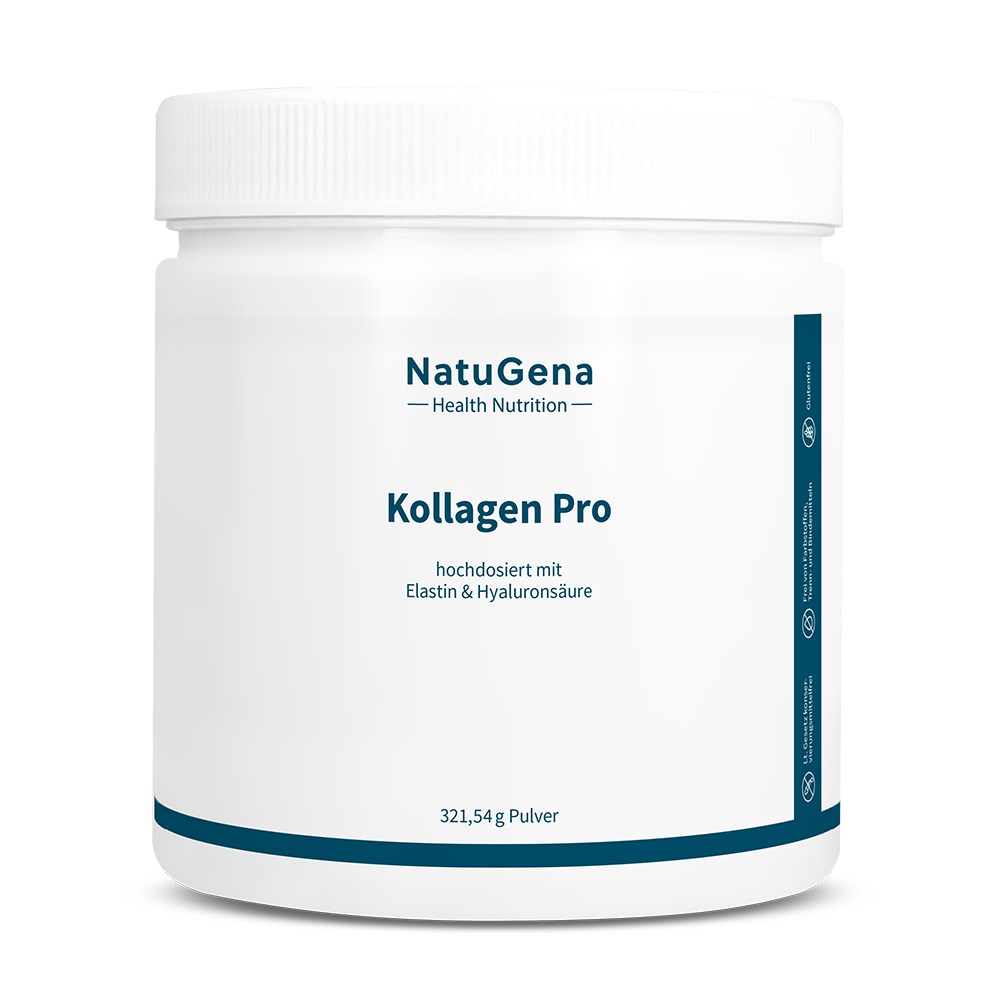
Collagen Pro
Peptan B 2000 LD with elastin and hyaluronic acid
Sensibly supplemented with vitamin C, vitamin B7 and silicon. Neutral in taste and completely soluble.


44,95 €
Other Articles

26.10.2026 Claudia Dippel, Heilpraktikerin
Nucleotides – The Underestimated Building Blocks of Life
Most people are familiar with amino acids – as the building blocks of proteins, essential for muscles, enzymes, and signaling molecules. Awareness of their importance has grown considerably in recent years. However, what many people are less familiar with are nucleotides, a group of substances that play a role at an even more fundamental biological level.
Read more
22.10.2026 Redaktion
Blue Light and Sleep: How Our Daily Habits Disrupt the Sleep-Wake Cycle
Using smartphones, working on computers, and streaming TV series – especially right before bedtime – can interfere with the function of our pineal gland. Among other things, this small gland regulates the release of the hormone melatonin, which is normally produced in greater amounts as darkness falls in the evening.
Read more
16.10.2026 Redaktion
Daylight Saving Time and Sleep Problems: Why Does Your Internal Clock Resist the Time Change?
The alarm goes off, but your head feels heavy. Although the clocks are turned back by one hour in autumn, seemingly allowing more time for rest, your usual routine can be thrown off balance. Many people struggle to fall asleep in the evening or wake up feeling exhausted.
Read more