
08.06.2026 Dr. David Hauck
Sun protection is more than just UV protection
Photoaging is one of the key factors in skin aging and wrinkle formation. In addition, exposure to light and sunlight is a major risk factor for skin cancer. Anyone who wants to protect themselves effectively should consider more than just UV radiation.
During my talks, I often ask my audience whether they generally use sunscreen or a day cream with a sun protection filter, which most of them confirm. When I ask if they feel protected from the sun and light by using these products, everyone is convinced they are. But that’s not the case.
This is because sun protection filters in cosmetics only protect against UV radiation—and thus against the sunburn it causes. Although UV rays are the strongest and most intense component of solar radiation, they account for less than ten percent of the total radiation. The remaining radiation consists, in roughly equal proportions, of visible light and infrared radiation. The sunscreens in sunscreens do not protect against these. But infrared light and visible light also promote oxidation and the formation of free radicals, leading to skin aging, DNA damage, and cellular damage.
Preventing Cell Damage
To draw a somewhat extreme comparison: if I drink an entire bottle of vodka while taking painkillers at the same time, I may feel the effects of the alcohol are somewhat mitigated, but my cells have still been severely damaged. The same applies to sunscreen. I may not get sunburned, but I still suffer cell damage. — So what can we do?
Since there is currently no active protection against visible light and infrared radiation, we’re left with only two options. Either we’re careful with light and sun exposure, or we try to largely neutralize the effects of free radicals by taking antioxidants internally or applying them externally.
We can learn from the Spanish how to manage our sun exposure wisely to avoid the strongest radiation. That means taking a siesta between 11:00 a.m. and 3:00 p.m. During this time in the summer, they stay out of the sun. In addition, wide-brimmed sombrero hats are perfect for keeping the sun off your face. It doesn’t have to be an oversized, fashionable sombrero. But a baseball cap or another stylish hat is also a good way to protect your face. Furthermore, your body should always be covered with at least a thin layer of fabric.
Astaxanthin from the Inside and Outside
Even though sunscreens or day creams with SPF protect exclusively against UV radiation, I strongly recommend using them. It’s best to use them in combination with a serum that contains powerful antioxidants to protect yourself from free radicals and, consequently, from photoaging. Simply put, antioxidants act as a kind of protective shield, as they themselves are destroyed more quickly by light exposure than skin cells and thus sacrifice themselves.
In general, however, it is difficult for consumers to assess which antioxidants are effective and stable and how they actually reach the correct site of action. OPC, vitamin C, and vitamin A are not particularly well-suited to neutralizing free radicals caused by the sun. Carotenoids such as astaxanthin or vitamin E are better suited for this purpose because they are more stable and more effective against free radicals caused by radiation.
My personal favorite, based on decades of antioxidant research, is carotenoids—and within this group, natural astaxanthin. Astaxanthin is essentially a substance produced naturally by the body and can be obtained entirely naturally from a specific freshwater algae.
It can be stably incorporated into the skin and is highly effective against free radicals. In studies using skin models, it has been shown to provide up to 99% protection. Another advantage is its color, as the active ingredient is easily visible due to its faint pink or orange hue. If the color is no longer present, the product is no longer effective. This visual indicator is not present in other antioxidants found in creams. They can degrade during storage, and the customer has no way of knowing whether the active ingredient in the cream is still active.
Synthetically produced astaxanthin generally has a weaker effect. This “power algae” is a true gem among antioxidants and is sustainably produced, for example, in Austria by the company BDI Bio Life Science.
When taken internally, fat-soluble antioxidants such as carotenoids can also provide protection. Studies by the Charité Research Institute in Berlin have shown that they can accumulate in the skin over time and form a reservoir that the body then draws upon in response to sunlight, illness, or oxidative stress. Competitive athletes who are exposed to significant amounts of sunlight also take advantage of this accumulation in the skin. This can improve their natural protection against light and sunburn by up to 25%.
The Effects of Blue Light
A relatively new trend in lighting research is blue light from the visible light spectrum. Due to artificial lighting such as LEDs, computer screens, and mobile devices, we are increasingly exposed to this light in addition to normal sunlight. Our skin—and especially our eyes—are affected by it.
The result is premature skin aging. This applies to both the skin and the eyes. Although antioxidants such as lutein and astaxanthin—obtained through our diet—are stored in the retina, they protect our eyes in two ways: Actively by absorbing blue light and passively by neutralizing free radicals. However, we should be mindful to practice a certain degree of “digital hygiene” and, in addition, eat a colorful, varied diet to protect our eyes from premature aging and the resulting loss of vision.
Concerns About UV Filters
A brief digression on the topic of UV filters. These are extremely important for us humans, but for decades there has been critical debate about whether they also pose risks. There is suspicion that certain UV filters may have radical-forming, carcinogenic, or endocrine-disrupting effects. For this reason, they are under scrutiny or have even disappeared from the market entirely. The U.S. Food and Drug Administration (FDA) repeatedly receives inquiries regarding their safety and efficacy.
Older sunscreens, in particular, raise safety concerns. Therefore, SPF creams should be used up quickly, and sunscreen should only be used for one season.
The environment is also facing serious challenges. Hawaii has banned certain filters because they are difficult to break down and harm marine life, such as coral reefs. These substances, which do not belong there, have also been found in Swiss mountain lakes and in human breast milk.
References
F. J. Pashkow, D. G. Watumull, and C. L. Campbell, “Astaxanthin: a novel potential treatment for oxidative stress and inflammation in cardiovascular disease,” Am. J. Cardiol., vol. 101, no. 10A, pp. 58D–68D, May 2008.
R. D. Jager, W. F. Mieler, and J. W. Miller, “Age-related macular degeneration,” N. Engl. J. Med., vol. 358, no. 24, pp. 2606–2617, June 2008
Schlumpf M et al.: Endocrine activity and developmental toxicity of cosmetic UV filters—an update. Toxicology 2004; 205: 113–122
Schlumpf M et al.: Developmental toxicity of UV filters and environmental exposure. Int. J. Andrology 2008; 31: 144–145
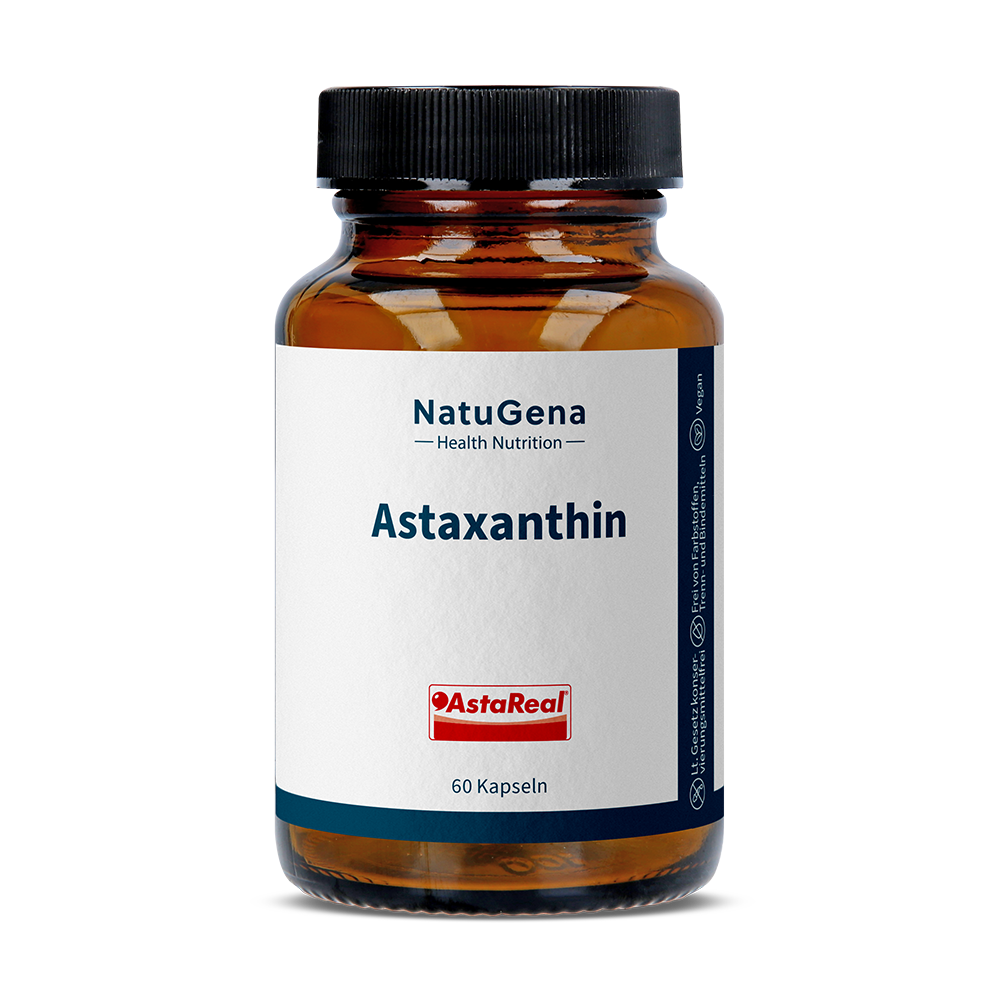
Astaxanthin
AstaReal®
Natural astaxanthin from the microalga Haematococcus pluvialis, featuring the branded ingredient AstaReal®.


44,95 €
Other Articles

22.10.2026 Redaktion
Blue Light and Sleep: How Our Daily Habits Disrupt the Sleep-Wake Cycle
Using smartphones, working on computers, and streaming TV series – especially right before bedtime – can interfere with the function of our pineal gland. Among other things, this small gland regulates the release of the hormone melatonin, which is normally produced in greater amounts as darkness falls in the evening.
Read more
16.10.2026 Redaktion
Daylight Saving Time and Sleep Problems: Why Does Your Internal Clock Resist the Time Change?
The alarm goes off, but your head feels heavy. Although the clocks are turned back by one hour in autumn, seemingly allowing more time for rest, your usual routine can be thrown off balance. Many people struggle to fall asleep in the evening or wake up feeling exhausted.
Read more
12.10.2026 Redaktion
Omega-3 for Children: What Parents Should Keep in Mind in Everyday Family Life
Many parents are familiar with situations like these: Their child seems restless, has difficulty concentrating, or quickly feels overwhelmed. Homework takes forever, attention constantly shifts, and at the same time, the child finds it difficult to relax.
Read more