
27.11.2026 Magdalena Meier, M.Sc. Biologie
A Multivitamin a Day Keeps the Doctor Away?
Anyone who wants to stay healthy in the long term usually thinks first of nutrition, exercise, sleep, and stress management. These fundamentals cannot be replaced by dietary supplements. Nevertheless, selected multinutrient supplements can help complement the daily intake of various micronutrients, particularly when the diet is not optimally balanced every day or when nutritional needs change during certain stages of life.
The key is not to follow the principle that "more is better." Instead, a different approach is increasingly gaining attention: a broad spectrum of nutrients in moderate doses, combining various nutrients in amounts that make nutritional sense.
Why Moderately Dosed Multinutrient Supplements Are Worth Considering
Vitamins and minerals do not act in isolation within the metabolism. They are involved in numerous interconnected processes and perform functions related to energy metabolism, the immune system, protecting cells against oxidative stress, and the normal functioning of the nervous system.
A moderately dosed multinutrient supplement therefore takes a different approach from a high-dose single-nutrient supplement: rather than supplying as much as possible of one particular nutrient, it aims to complement the diet in several ways.
Science writer Bas Kast also advocates moderately dosed multivitamin supplements in his book "Vitaminkompass" and accompanying interviews, drawing on his extensive research.
Healthy Aging: Scientific Evidence Is Becoming More Concrete
An increasing number of large-scale randomized studies are now investigating the question: Could regular, moderate supplementation with multiple micronutrients also influence certain aspects of the aging process? Findings from the large COSMOS series of studies are particularly interesting in this regard.
Multivitamins and Biological Aging Markers
An analysis published in Nature Medicine in 2026 examined 958 participants from the randomized COSMOS trial to determine whether daily multivitamin and mineral supplementation could produce measurable changes in various epigenetic aging markers.
The researchers examined several so-called epigenetic clocks, which use DNA methylation patterns to estimate certain aspects of biological aging. For some of these markers, the multivitamin group showed a statistically significant, more favorable change over the study period. These findings provide intriguing evidence that moderate micronutrient supplementation may even be reflected at the molecular level in certain biomarkers associated with human aging.
This adds a new dimension to the discussion about optimal micronutrient intake. The focus is no longer exclusively on addressing individual nutrient gaps, but increasingly on understanding the potential importance of consistent, broad-spectrum micronutrient intake for healthy aging.
Memory and Cognitive Aging: Findings from COSMOS
The findings regarding cognitive performance are even more concrete.
In several randomized COSMOS substudies, older adults received either a daily multivitamin and mineral supplement or a placebo over several years. A subsequent meta-analysis of the three COSMOS cognition studies found a consistent benefit in the multivitamin group regarding global cognitive function and episodic memory in particular.
The researchers estimated that the magnitude of the observed effect could correspond to approximately a two-year delay in age-related cognitive decline.
These are remarkable findings! However, it remains important to emphasize that a multivitamin supplement does not prevent dementia, nor can it replace physical activity, a balanced diet, or other measures that support brain health. Nevertheless, the results suggest that regular, moderate micronutrient supplementation may be more relevant to maintaining cognitive function in older age than previously assumed.
A good supply of nutrients can therefore contribute to healthy aging. Moderately dosed multinutrient supplements may help address nutritional gaps.
Healthy Aging Is About More Than Supplementation
The importance of an overall healthy lifestyle was particularly evident in a randomized controlled trial published in 2024 under the leadership of Dean Ornish.
The study involved people with mild cognitive impairment or early dementia due to Alzheimer's disease. Over a period of 20 weeks, the intervention group followed a comprehensive program combining a predominantly plant-based diet, physical activity, stress management, social support, and selected dietary supplements.
Compared with the control group, statistically significant differences were observed in several measures of cognitive function. Some participants experienced improvements in cognitive and functional parameters, while these measures generally deteriorated in the control group.
However, it is difficult to determine which of the many interventions was responsible for the observed differences. Nevertheless, the findings clearly highlight the importance of a healthy lifestyle in relation to human aging. Incidentally, it is never too late to make positive lifestyle changes.
SpektrA-Z: Comprehensive Nutritional Support from Vitamin A to Zinc
A balanced supply of vitamins and minerals is an important foundation for numerous bodily functions at every stage of life. SpektrA-Z combines a broad spectrum of vitamins and minerals with selected plant compounds, making it a versatile multinutrient supplement to complement the daily diet.
Of particular interest is the combination of bioactive vitamin forms, organically bound minerals, and plant extracts such as camu camu, cocoa bean, bladderwrack, and marigold. These provide vitamin C, polyphenols, iodine, and lutein, among other substances.
The vitamins and minerals included perform a wide range of functions: B vitamins and magnesium contribute to normal energy metabolism, while vitamin C, vitamin E, zinc, and selenium help protect cells from oxidative stress. SpektrA-Z thus combines essential micronutrients and selected plant ingredients in a gently formulated, comprehensive blend.
Organic Moringa: A Natural Multivitamin?
It is also worth looking at herbal medicine: Moringa oleifera has long been used as a food due to its nutrient-rich leaves. Dried moringa leaves naturally contain various minerals, vitamins, and plant compounds.
A product based on Organic Moringa can therefore be regarded as a type of plant-based nutrient matrix. Rather than providing just one isolated substance, the plant supplies a wide variety of natural components. This broad composition is precisely what makes moringa interesting as an ingredient in a gently dosed multinutrient supplement.
Additional Protein Building Blocks: OktaAmino
In addition to vitamins and minerals, amino acids play a central role in nutrition. The body cannot produce essential amino acids itself, so they must be obtained through the diet. Among other functions, they serve as building blocks for the body's own protein synthesis.
OktaAmino combines eight essential amino acids in their free form. Its composition is based on an amino acid pattern developed by Dr. Maurizio Lucà-Moretti. Studies on nitrogen utilization have been published in connection with this concept, comparing the amino acid mixture with egg protein, among other things. It is particularly well tolerated and produces only small amounts of ammonia byproducts during metabolism.
And What About Creatine?
Another nutrient is attracting increasing scientific attention in connection with healthy aging: creatine.
Creatine is primarily known from the world of sports. However, its physiological importance extends beyond athletic performance, as the creatine-phosphocreatine system plays an important role in the rapid provision of energy in the form of ATP, not only in muscles but also in the brain.
Creatine is therefore of particular scientific interest in older age. A recent systematic review examining creatine and cognition in adults aged 55 and older found positive associations in five of the six included studies, particularly regarding memory and attention. However, the authors explicitly emphasize that the current evidence remains limited and that further high-quality randomized studies are needed.
Putting the Findings into Perspective
Research conducted in recent years has made it clear just how multifaceted healthy aging is and that adequate micronutrient intake may also play a role.
New studies are expanding this understanding. They provide indications that consistent, moderate micronutrient supplementation may not only address traditional nutritional gaps but could also be associated with cognitive function and certain biological aging markers.
For a long and healthy life, however, the familiar combination of lifestyle factors remains essential: a nutrient-rich, predominantly plant-based diet, regular physical activity and strength training in particular, restorative sleep, social connections, conscious stress management, and targeted nutrient supplementation where individually appropriate.
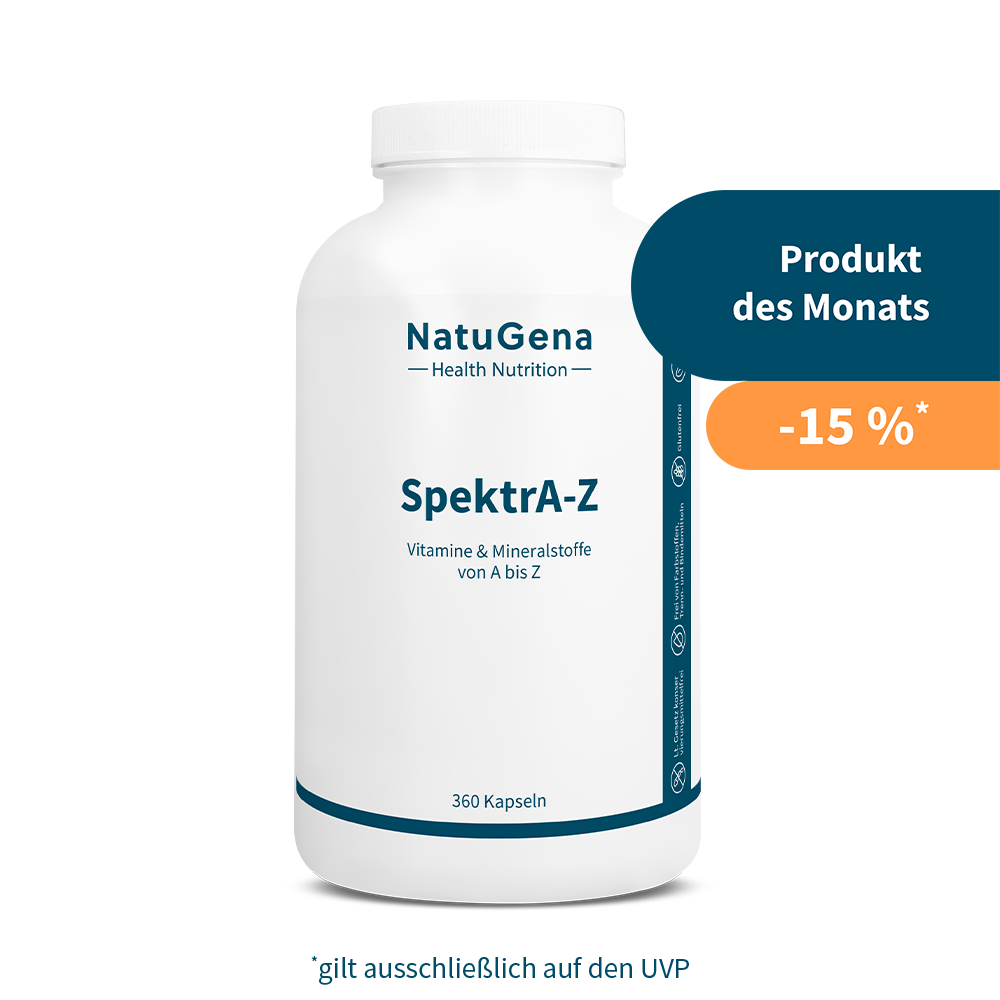
SpektrA-Z
From vitamin A to zinc
Offers a broad spectrum of bioactive vitamins and minerals, and contains valuable phytonutrients such as lutein and polyphenols.


50,96 €
Other Articles

24.11.2026 Claudia Dippel, Heilpraktikerin
Men's Health: Prostate and Bladder
For both women and men, bladder leakage or a constant feeling of pressure on the bladder can be an uncomfortable subject. For men, there is often the additional issue of bothersome post-void dribbling. The cause frequently lies in the prostate.
Read more
18.11.2026 Magdalena Meier, M.Sc. Biologie
Which Blood Tests Are Important? What a Complete Blood Count Reveals and What It Doesn't
Many people have regular blood tests and assume that these provide a comprehensive overview of their health. However, this is where a common misunderstanding arises. A standard complete blood count (CBC) with differential primarily examines the different types of blood cells and provides only limited information about the body's actual nutrient status or metabolic processes.
Read more
05.11.2026 Claudia Dippel, Heilpraktikerin
Water Retention and Heavy Legs in Winter
It's warm indoors, cold and wet outside, and suddenly something feels uncomfortable: Your shoes seem too tight, sock marks are clearly visible around your ankles, and your legs feel unusually heavy and swollen. Many people associate this phenomenon with the hot summer months. But water retention can also occur during the colder seasons.
Read more