
07.07.2025 Kyra Kauffmann
Healthy bones: The underestimated key to longevity
When it comes to longevity, most people immediately think of a strong heart, a clear mind, and healthy joints. But what is often forgotten is that without strong bones, running a marathon at 70 won't do you any good if you fall down the basement stairs and can't get up again. Pain. Fractures. Loss of mobility. Those who fall at an advanced age risk more than just a leg in a cast. Independence dwindles—sometimes permanently.
Osteoporosis – an underestimated widespread disease
Bones are not dead structures. They are living organs that break down, build up, store, and react every day – like small construction sites in continuous operation. But this is precisely what makes them vulnerable if they are not given what they need on a daily basis. The silent decline begins earlier than you might think: it starts around the age of 30. Unnoticed. Year after year, we lose bone substance – until something cracks.
The tricky thing is that osteoporosis, a widespread disease, does not hurt for a long time. Until suddenly there is a crack. And that is exactly what makes it so dangerous. In Germany, it affects over 6 million people, with around 900,000 new cases each year. Almost one in twelve German citizens is affected – but hardly anyone talks about it. (1) Women over 60 are particularly affected. But men are not spared either: 17% overlook the danger because osteoporosis is mistakenly considered a “women's issue.” Osteoporosis begins insidiously and completely symptom-free, whether in your early or mid-40s. (2) Targeted prevention should begin at this point at the latest.
Early detection? Unfortunately, no.
Prevention also means early detection, i.e., getting an overview of your own bone health. This can be done with a DXA measurement to determine bone density. Health insurance companies usually only cover this once the first fracture has already occurred. Prevention is a private matter in this country. Around €70 for a DXA measurement is, in my opinion, money well spent. But hardly anyone knows about it. I myself go every 5 years to keep an eye on my bone health and advise my patients aged 45 and over to do the same.
Trauma surgeons such as Prof. Wolfgang Böcker say it clearly: “Osteoporosis is the best referral source for trauma surgeons today.” He even calls it “an absolutely deadly widespread disease.” (3)
Even more bitter: after an osteoporosis-related bone fracture, 90% of women and 97% of men receive no further treatment. No medication. No treatment plan. (3)
Two strong pillars for strong bones
So what can you do? You have no choice: if you don't want to compromise on bone health, you have to take matters into your own hands. Your personal bone protection program consists of two pillars:
- Micronutrients
- Exercise – especially strength training
If you only think of calcium and vitamin D when it comes to bone health, you are falling short. Our bone system is a high-performance operation. It needs building materials, auxiliary materials, and operating materials. You must provide it with sufficient quantities of these every day. A quick look at the bone workshop, beyond vitamin D:
- Magnesium – activates vitamin D and aids mineralization (4)
- Phosphate – without it, calcium metabolism goes awry (4)
- Vitamin K2 – ensures that calcium migrates into the bones, not into the blood vessels (5)
- Manganese & vitamin C – important for the collagen structure of the bones (4)
- Copper – stabilizes the collagen network (4)
- Arginine & lysine – boost the building cells and calcium storage (7)
- Selenium – is stored in the bones and aids regeneration (6)
- Collagen type 1 – the basic framework of the bones (7)
And then there is another player that is often overlooked:
Boron – the conductor in the nutrient orchestra
Boron is little known in medicine, but your bones know it well. In practice, it has been shown time and again that a lack of boron throws the entire bone metabolism out of sync. (8)
It acts like a silent coordinator:
- slows down the breakdown of vitamin D
- increases the bioavailability of magnesium and calcium
- reduces their excretion
- also increases bone-related hormone levels (e.g., testosterone in men, estrogen in women) (8)
In one study, free testosterone levels in men increased significantly after just one week of taking 6 mg of boron per day. (9)
Strength training – medicine with dumbbells
Yoga is great. So are walking and Pilates. But that's often not enough for strong bones. What they really need is stress. Tension. Pressure. Weight. This is the only way to activate osteoblasts (the “construction worker cells”) to strengthen the structure. (10)
Strength training from the age of 30? Yes, absolutely. The earlier, the better. Studies show that it slows down bone loss – and can even reverse it. Women who exercised regularly lost only 1.8% of their bone density over several years. Without exercise, the loss was around 10%. From the age of 40 onwards, strength training is just as important as healthy sleep, an anti-inflammatory diet, and stress management. Two to three intensive sessions per week are sufficient. The main thing is to exercise regularly and challenge yourself.
Conclusion: Without strong bones, everything else is meaningless
If you want to age healthily, you need to take care of not only your heart, brain, and muscles, but also your skeleton.
So don't neglect your bones. They will carry you throughout your entire life—hopefully a long one.
Bibliography
(1)https://leitlinien.dv-osteologie.org/kapitel/3-praevalenz-und-inzidenz-der-osteoporose-und-ihrer-folgen-soziooekonomische-relevanz/ (abgerufen Mai 2025)
(2) https://www.aerzteblatt.de/archiv/134111/Epidemiologie-der-Osteoporose-Bone-Evaluation-Study (abgerufen Mai 2025)
(3) https://www.sueddeutsche.de/gesundheit/osteoporose-krankheit-vorsorge-behandlung-1.4517479 (abgerufen Mai 2025)
(4) Skalny AV, Korobeinikova TV, Aschner M, Paoliello MMB, Lu R, Skalny AA, Mazaletskaya AL, Tinkov AA. Hair and Serum Trace Element and Mineral Levels Profiles in Women with Premenopausal and Postmenopausal Osteoporosis. Biol Trace Elem Res. 2023 Dec 1. doi: 10.1007/s12011-023-03970-z. Epub ahead of print. PMID: 38038893.
(5) Hirashima S, Kiyooka Y, Kaetsu S, Nakagawa K. Vitamin K converting enzyme UBIAD1 plays an important role in osteogenesis and chondrogenesis in mice. Biochem Biophys Res Commun. 2024 Apr 2;702:149635. doi: 10.1016/j.bbrc.2024.149635. Epub 2024 Feb 5. PMID: 38335702.
(6) Li J, Li H, Ullah A, Yao S, Lyu Q, Kou G. Causal Effect of Selenium Levels on Osteoporosis: A Mendelian Randomization Study. Nutrients. 2023 Dec 11;15(24):5065. doi: 10.3390/nu15245065. PMID: 38140324; PMCID: PMC10746097.
(7) https://www.medical-tribune.de/medizin-und-forschung/artikel/aminosaeuren-an-die-knochen (abgerufen Mai 2025)
(8) Rababah T, Aludatt M, Gammoh S, Salameh FB, Magableh G, Almajwal A, Yücel S, Al-Rayyan Y, Al-Rayyan N. A pilot study investigating the influence of dietary boron levels on osteoporosis in postmenopausal women. Food Sci Nutr. 2024 May 19;12(8):5708-5721. doi: 10.1002/fsn3.4218. PMID: 39139931; PMCID: PMC11317700.
(9) Khaliq H. Exploring the role of boron-containing compounds in biological systems: Potential applications and key challenges. J Trace Elem Med Biol. 2025 Jan 10;87:127594. doi: 10.1016/j.jtemb.2025.127594. Epub ahead of print. PMID: 39826267.
(10) Kemmler W, von Stengel S, Kohl M. Exercise frequency and bone mineral density development in exercising postmenopausal osteopenic women. Is there a critical dose of exercise for affecting bone? Results of the Erlangen Fitness and Osteoporosis Prevention Study. Bone. 2016 Aug;89:1-6. doi: 10.1016/j.bone.2016.04.019. Epub 2016 Apr 21. PMID: 27108341.
(11) Mohebbi R, Shojaa M, Kohl M, von Stengel S, Jakob F, Kerschan-Schindl K, Lange U, Peters S, Thomasius F, Uder M, Kemmler W. Exercise training and bone mineral density in postmenopausal women: an updated systematic review and meta-analysis of intervention studies with emphasis on potential moderators. Osteoporos Int. 2023 Jul;34(7):1145-1178. doi: 10.1007/s00198-023-06682-1. Epub 2023 Feb 7. PMID: 36749350; PMCID: PMC10282053.
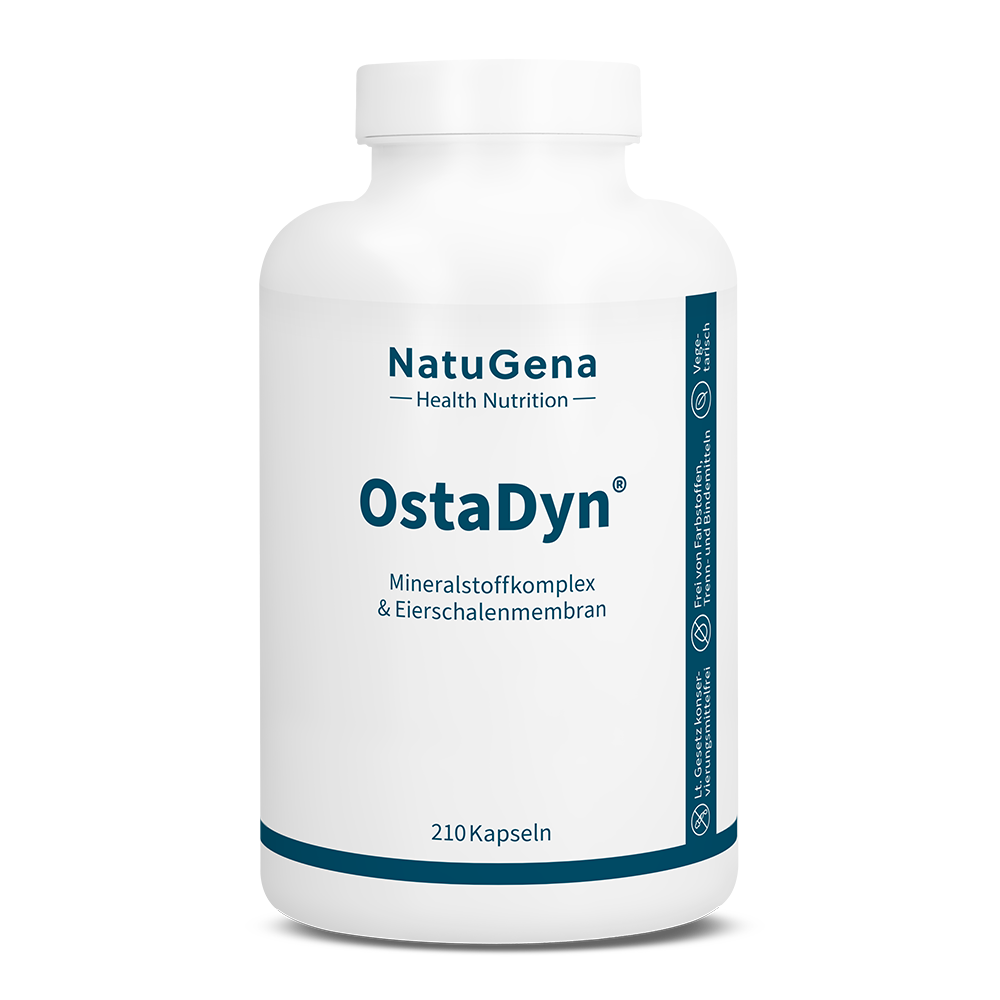
OstaDyn (bones)
Calcium, Magnesium & Eggshell Membrane
Comprehensive combination of organically bound minerals and high-dose vitamins. Includes the branded ingredient OVOMET®.


44,95 €
Other Articles
26.10.2026 Claudia Dippel, Heilpraktikerin
Nucleotides – The Underestimated Building Blocks of Life
Most people are familiar with amino acids – as the building blocks of proteins, essential for muscles, enzymes, and signaling molecules. Awareness of their importance has grown considerably in recent years. However, what many people are less familiar with are nucleotides, a group of substances that play a role at an even more fundamental biological level.
Read more
22.10.2026 Redaktion
Blue Light and Sleep: How Our Daily Habits Disrupt the Sleep-Wake Cycle
Using smartphones, working on computers, and streaming TV series – especially right before bedtime – can interfere with the function of our pineal gland. Among other things, this small gland regulates the release of the hormone melatonin, which is normally produced in greater amounts as darkness falls in the evening.
Read more
16.10.2026 Redaktion
Daylight Saving Time and Sleep Problems: Why Does Your Internal Clock Resist the Time Change?
The alarm goes off, but your head feels heavy. Although the clocks are turned back by one hour in autumn, seemingly allowing more time for rest, your usual routine can be thrown off balance. Many people struggle to fall asleep in the evening or wake up feeling exhausted.
Read more