• Mon–Fri 08:30–17:00
  • +49 841 90 255 000
  • +49 841 90 255 999
  • info@natugena.de
  • Login

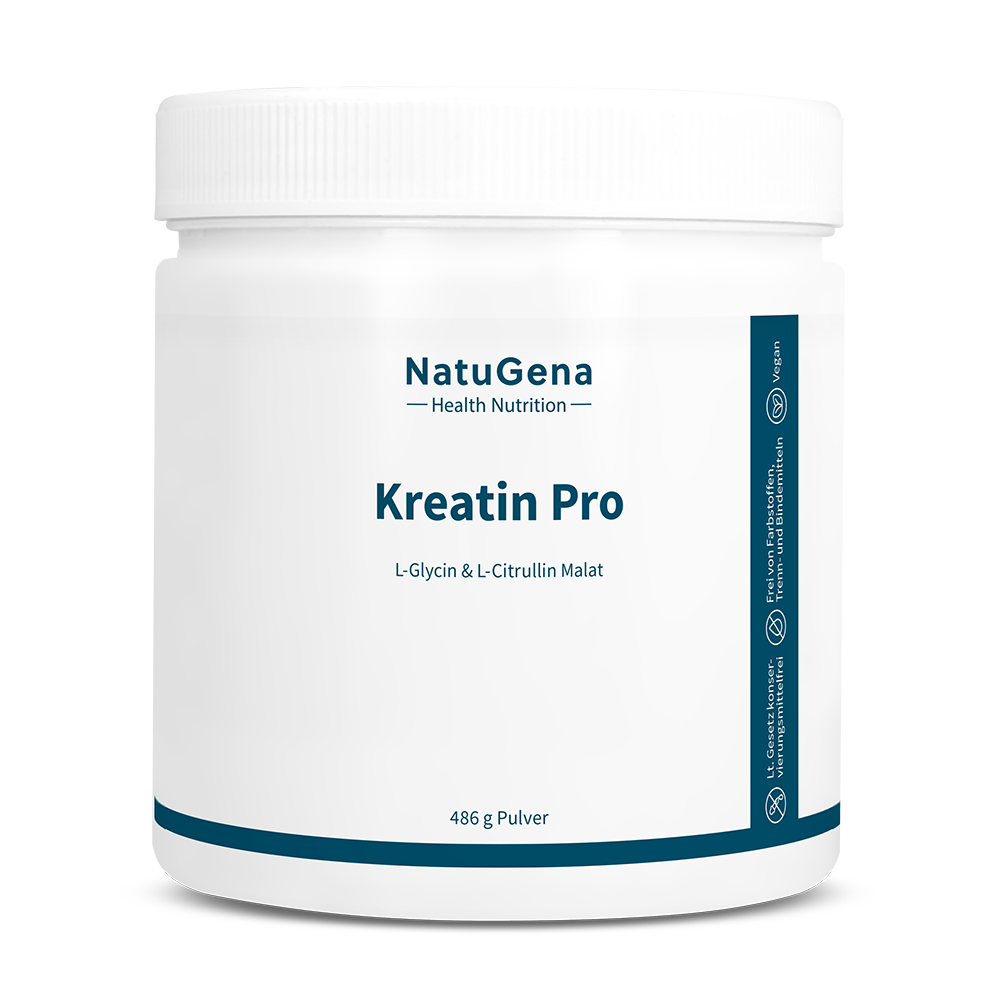
Creatine Pro

Creatine, Glycine, Citrulline malate
farbstofffrei glutenfrei laut Gesetz konservierungsmittelfrei laktosefrei trenn- und bindemittelfrei vegetarisch vegan

Nutritional Supplement

486 g powder for 90 days

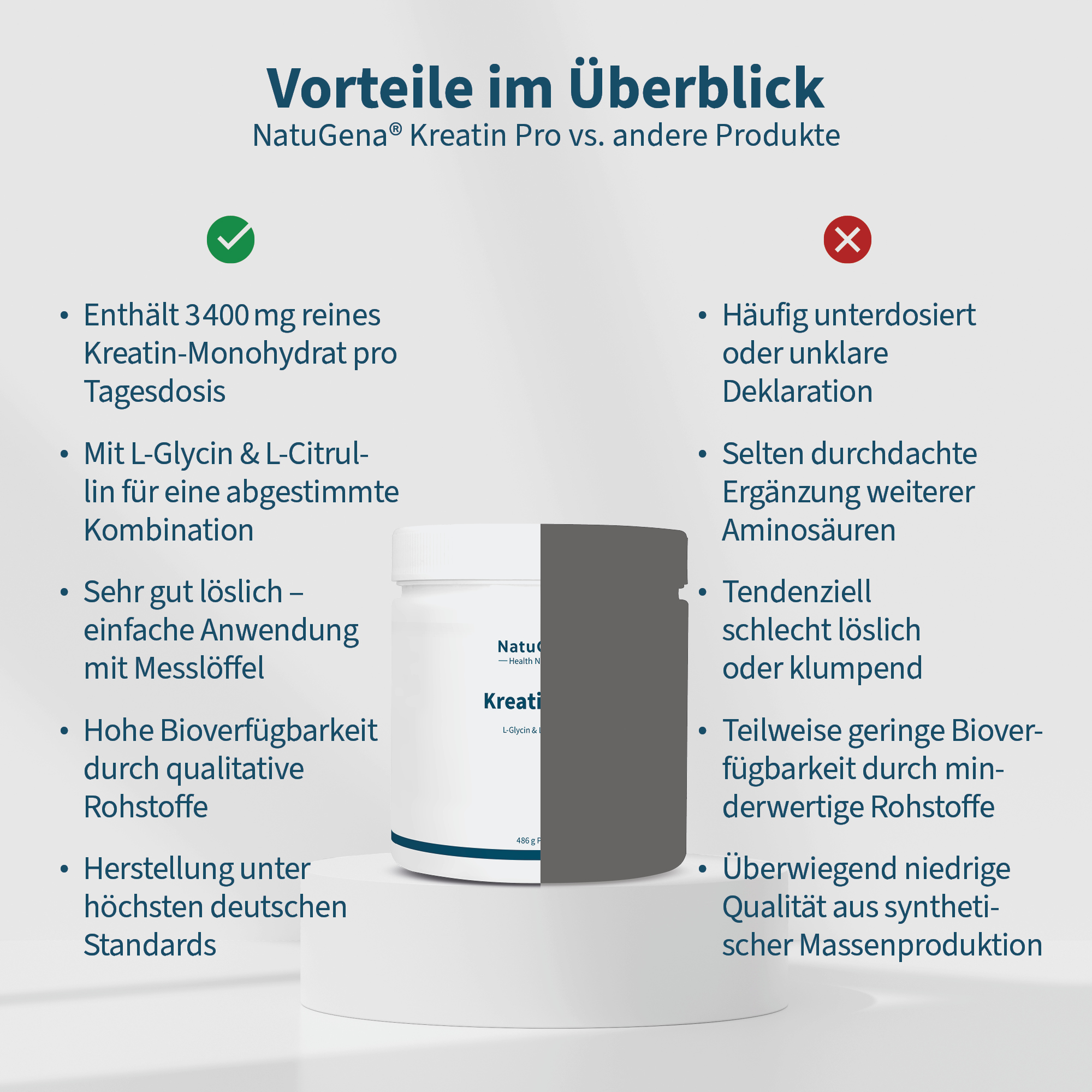
  • Contains creatine monohydrate, L-glycine and L-citrulline malate
  • Creatine increases physical performance in successive bursts of short-term, high-intensity exercise*
  • Creatine may enhance the effect of resistance training on muscle strength in adults over 55 years**
  • Suitable for vegetarians and vegans
  • Includes a practical measuring scoop
  • Premium-quality raw materials, produced in Germany

This product is tested on a batch-by-batch basis by an independent, accredited laboratory for the presence of steroids and anabolic substances.

32,95
Quantity Price
from 132,95 €
from 329,95 €
from 528,95 €
Orderable
Delivery time 3–5 workdays Article No.: 2018291
PPN/PZN: 11 20338623 45 (PZN = middle digits)
EAN: 4260633572916
base price: 67,55 € per Kilogramm
incl. 7% VAT, plus shipping costs

Creatine Pro by NatuGena – High-quality creatine monohydrate combined with the amino acids L-glycine and L-citrulline in a functional powder blend. A premium formula for active individuals with a naturally mild sweet–tart flavour.
486 g powder for a 3-month supply.

  • Creatine monohydrate: Highly pure form of creatine
  • L-glycine: Amino acid providing meaningful nutritional support
  • L-citrulline malate: Amino acid precursor, functionally aligned with the formula
  • Gluten-free: For broad tolerability
  • Produced in Germany: Exceptional purity and bioavailability for optimal nutrient uptake

Strength training, explosive power sports and periods of intense physical effort place high demands on the body. Regular training increases the need for targeted nutrients that support energy availability and muscle performance. Creatine Pro combines highly pure creatine monohydrate with the amino acids L-glycine and L-citrulline malate in a purposeful blend.

What is creatine?

Creatine is a compound naturally produced in the body and stored in limited amounts in muscle tissue, where it plays a key role in rapid energy supply. Although often referred to as an amino acid, creatine is actually a tripeptide formed from three amino acids.
During intense or short-term high-power efforts, creatine stores are heavily used. Supplementation can therefore be beneficial, as it contributes to improved performance during these training phases.* For adults over 55, creatine has also been shown to enhance the effects of regular resistance training on muscle strength.**

Why do L-glycine and L-citrulline malate complement the formula?

Creatine Pro combines proven creatine monohydrate with L-glycine and L-citrulline. Glycine is a natural component of the body’s creatine metabolic pathway. Citrulline functionally enhances the formula because it is a precursor to arginine, an amino acid involved in nitrogen metabolism.

* Creatine increases physical performance in successive bursts of short-term, high-intensity exercise. The beneficial effect is obtained with a daily intake of 3 g creatine.

** Daily creatine intake can enhance the effect of resistance training on muscle strength in adults over 55.
This claim applies to adults over 55 who perform regular resistance training. The beneficial effect is obtained with a daily intake of 3 g creatine combined with resistance training that can be progressively increased over time and is performed at least three times per week for several weeks, at an intensity of 65–75 % of one-repetition maximum.

Recommended intake

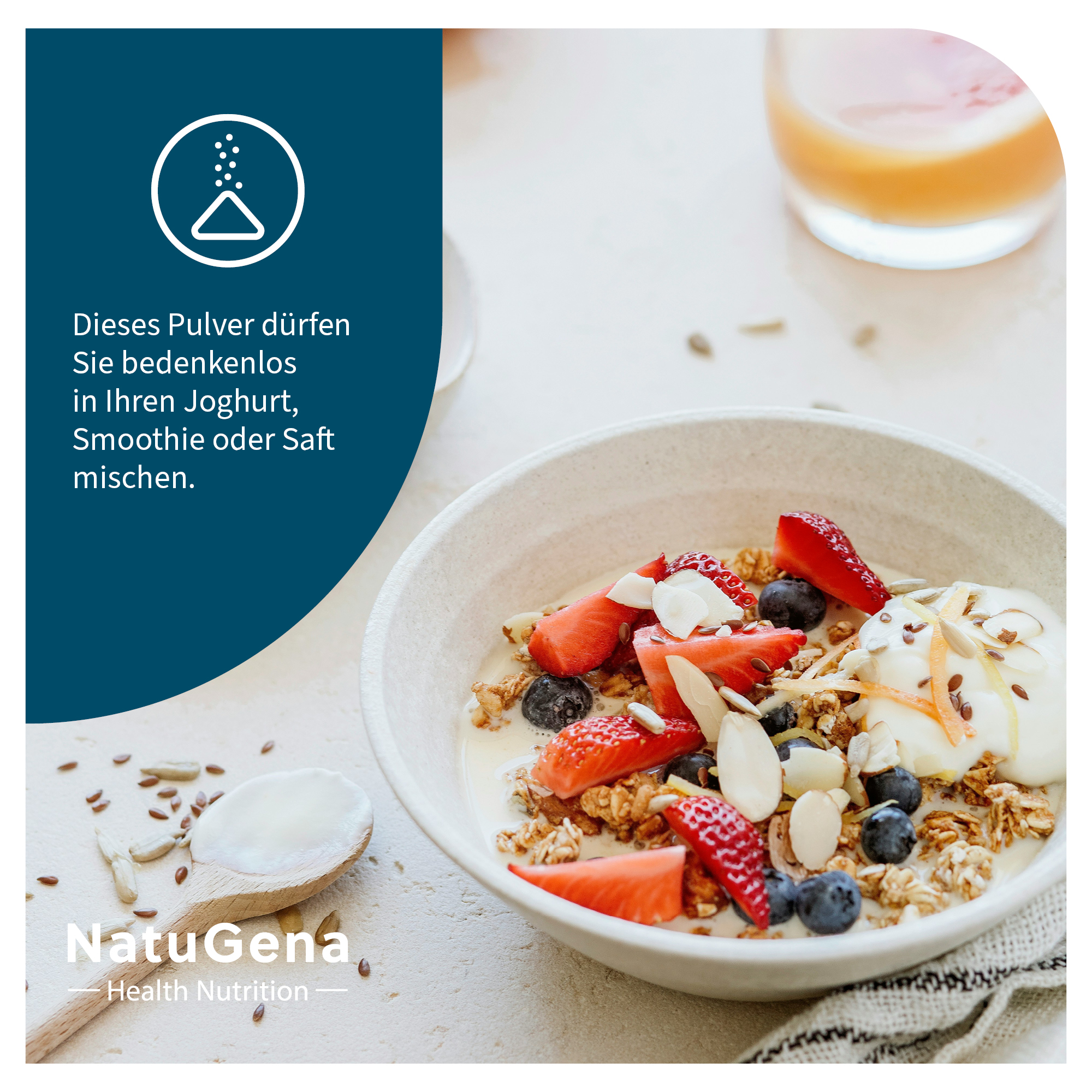
5.4 g powder (equivalent to 1 measuring spoon) once a day. The measuring spoon is included. For best results, take at least 30 minutes before or 90 minutes after a meal with 250 ml of still, lukewarm water or, alternatively, with half a freshly squeezed lemon.

Notes

Dietary supplements should not be used as a substitute for a balanced and varied diet and a healthy lifestyle. Keep out of reach of small children. Store sealed, cool, dry, and protected from light. Do not exceed the recommended daily intake.

Ingredients

Ingredients per daily dose
Creatine monohydrate 3400 mg
- of which Kreatin 3000  mg
L-glycine 1000 mg
L-citrulline malate 1000 mg
- of which L-citrulline 667 mg

1 Reference amounts for the average adult according to Regulation (EU) No. 1169/2011 (in %).

Zusammensetzung

Creatin monohydrate, L-glycine, L-citrulline-DL-malate (2:1).

Not a medicine.

Dietary supplement: Do not exceed the recommended daily intake. Not a substitute for a balanced and varied diet and a healthy lifestyle.

Pure substance principle

Only active ingredients (no excipients, no colorants, no preservatives according to law, no technological additives such as binding and separating agents, no hidden additives, free from gluten, flavor enhancers, lactose, flavors, soy).

Legal notice

This product is intended for nutritional purposes and is therefore not subject to the German Advertising of Medicines Act (HWG). A good nutritional status can help the body prevent or overcome diseases. All statements made about the product describe properties and physiological effects that may vary naturally among consumers and do not constitute any healing or health promises.

Selenium, zinc, vitamin D, and vitamin C contribute to the normal function of the immune system. In addition to our single-ingredient products, we also offer proven combination products with plant extracts, such as ParaBiotik or AnginKa.

Furthermore, iron, copper, vitamin A, vitamin B6, and folic acid contribute to the normal function of the immune system.

Colostrum contains important immunoglobulins (IgA, IgG, and IgM) that support the body as immune factors.

Have you heard of our Immune Set? It provides you with vitamin C, zinc & selenium, and vitamin D at a special price - enough for a 4-month supply to help you get through the winter.


We work with the independent laboratory AgroLab, which we commission to perform microbiological and heavy metal tests.

In our microbiological testing, we measure the aerobic mesophilic plate count (total plate count), as well as the levels of Escherichia coli (E. coli), yeasts, Salmonella, molds, and staphylococci.

For heavy metals, we test for arsenic, lead, cadmium, and mercury in accordance with the limit values specified in Regulation (EU) 2023/915.

The optimal time to take a supplement depends on the specific nutrient, individual tolerance, and the composition of the product. However, some ingredients can be particularly well suited to certain times of day or meals.

In the morning

Stimulating ingredients are often preferably taken in the morning or during the first half of the day. These include, for example:

  • Coenzyme Q10
  • Green tea extract
  • Certain B vitamins

Especially for sensitive individuals, it may be advisable to avoid taking stimulating ingredients immediately before bedtime.

Throughout the day

For some nutrients, it may be beneficial to divide the daily amount into several doses.

Water-soluble vitamins such as B vitamins and vitamin C can be taken throughout the day.

Magnesium can also be divided into several doses rather than taking the entire daily amount at once. This may improve tolerance, particularly with higher amounts.

In the evening

Depending on the type of magnesium compound, taking it in the evening may be beneficial. Magnesium glycinate, for example, is often preferably taken in the evening.

In general, however, the best time to take a product also depends on when it is individually best tolerated and can be reliably incorporated into your daily routine.

With a meal

Some nutrients benefit from being taken together with a meal.

Fat-soluble vitamins A, D, E, and K can be taken together and ideally with a meal containing some fat.

Omega-3 fatty acids should also be taken regularly with a meal. Omega-3 oils can be combined well with fat-soluble vitamins.

Many plant-based ingredients can also be taken as part of a meal or together with omega-3 products. However, the optimal timing depends on the specific plant compound and product formulation.

Zinc can cause nausea or stomach discomfort on an empty stomach in some people. If you have a sensitive stomach, it is therefore advisable to take zinc with a meal.

Between meals

Iron is often taken separately from meals, as various foods and beverages can affect its absorption. It is particularly advisable to leave a gap between iron and:

  • Coffee and tea
  • Caffeinated beverages
  • Milk and dairy products
  • Calcium- or mineral-rich supplements

However, if you have a sensitive stomach, iron can also be taken with a meal. In this case, individual tolerance is more important than a theoretically optimal intake situation.

Enzyme supplements vary depending on their intended use: digestive enzymes are generally taken with meals. Products that are specifically intended to be taken between meals may, for example, be taken around 30 minutes before a meal. The product's specific recommended intake should always be followed.

Around exercise

Proteins and amino acids can be taken both before and after training.

If you exercise on an empty stomach, taking them around 30 minutes before training may be beneficial. If you have already eaten a protein-rich meal, you can also plan your protein intake for after training.

In general, ensuring sufficient protein intake throughout the entire day is more important than adhering to a narrow time window around your workout.

The optimal duration of use depends on the specific nutrient, your initial situation, diet, and individual requirements.

There is therefore no one-size-fits-all recommendation for how long a product should be taken. For products intended to support nutrient intake over a longer period, use over several weeks to months may be appropriate. In many cases, a period of around three months may be suitable before nutrient status and further requirements are reassessed.

In the case of diagnosed deficiencies, medical conditions, or the use of medication, the use of supplements should be individually discussed with a doctor or qualified healthcare professional.

Creatine Pro by NatuGena – High-quality creatine monohydrate combined with the amino acids L-glycine and L-citrulline in a functional powder blend. A premium formula for active individuals with a naturally mild sweet–tart flavour.
486 g powder for a 3-month supply.

  • Creatine monohydrate: Highly pure form of creatine
  • L-glycine: Amino acid providing meaningful nutritional support
  • L-citrulline malate: Amino acid precursor, functionally aligned with the formula
  • Gluten-free: For broad tolerability
  • Produced in Germany: Exceptional purity and bioavailability for optimal nutrient uptake

Strength training, explosive power sports and periods of intense physical effort place high demands on the body. Regular training increases the need for targeted nutrients that support energy availability and muscle performance. Creatine Pro combines highly pure creatine monohydrate with the amino acids L-glycine and L-citrulline malate in a purposeful blend.

What is creatine?

Creatine is a compound naturally produced in the body and stored in limited amounts in muscle tissue, where it plays a key role in rapid energy supply. Although often referred to as an amino acid, creatine is actually a tripeptide formed from three amino acids.
During intense or short-term high-power efforts, creatine stores are heavily used. Supplementation can therefore be beneficial, as it contributes to improved performance during these training phases.* For adults over 55, creatine has also been shown to enhance the effects of regular resistance training on muscle strength.**

Why do L-glycine and L-citrulline malate complement the formula?

Creatine Pro combines proven creatine monohydrate with L-glycine and L-citrulline. Glycine is a natural component of the body’s creatine metabolic pathway. Citrulline functionally enhances the formula because it is a precursor to arginine, an amino acid involved in nitrogen metabolism.

* Creatine increases physical performance in successive bursts of short-term, high-intensity exercise. The beneficial effect is obtained with a daily intake of 3 g creatine.

** Daily creatine intake can enhance the effect of resistance training on muscle strength in adults over 55.
This claim applies to adults over 55 who perform regular resistance training. The beneficial effect is obtained with a daily intake of 3 g creatine combined with resistance training that can be progressively increased over time and is performed at least three times per week for several weeks, at an intensity of 65–75 % of one-repetition maximum.

Recommended intake

5.4 g powder (equivalent to 1 measuring spoon) once a day. The measuring spoon is included. For best results, take at least 30 minutes before or 90 minutes after a meal with 250 ml of still, lukewarm water or, alternatively, with half a freshly squeezed lemon.

Notes

Dietary supplements should not be used as a substitute for a balanced and varied diet and a healthy lifestyle. Keep out of reach of small children. Store sealed, cool, dry, and protected from light. Do not exceed the recommended daily intake.

Ingredients

Ingredients per daily dose
Creatine monohydrate 3400 mg
- of which Kreatin 3000  mg
L-glycine 1000 mg
L-citrulline malate 1000 mg
- of which L-citrulline 667 mg

1 Reference amounts for the average adult according to Regulation (EU) No. 1169/2011 (in %).

Zusammensetzung

Creatin monohydrate, L-glycine, L-citrulline-DL-malate (2:1).

Not a medicine.

Dietary supplement: Do not exceed the recommended daily intake. Not a substitute for a balanced and varied diet and a healthy lifestyle.

Pure substance principle

Only active ingredients (no excipients, no colorants, no preservatives according to law, no technological additives such as binding and separating agents, no hidden additives, free from gluten, flavor enhancers, lactose, flavors, soy).

Legal notice

This product is intended for nutritional purposes and is therefore not subject to the German Advertising of Medicines Act (HWG). A good nutritional status can help the body prevent or overcome diseases. All statements made about the product describe properties and physiological effects that may vary naturally among consumers and do not constitute any healing or health promises.

Selenium, zinc, vitamin D, and vitamin C contribute to the normal function of the immune system. In addition to our single-ingredient products, we also offer proven combination products with plant extracts, such as ParaBiotik or AnginKa.

Furthermore, iron, copper, vitamin A, vitamin B6, and folic acid contribute to the normal function of the immune system.

Colostrum contains important immunoglobulins (IgA, IgG, and IgM) that support the body as immune factors.

Have you heard of our Immune Set? It provides you with vitamin C, zinc & selenium, and vitamin D at a special price - enough for a 4-month supply to help you get through the winter.


We work with the independent laboratory AgroLab, which we commission to perform microbiological and heavy metal tests.

In our microbiological testing, we measure the aerobic mesophilic plate count (total plate count), as well as the levels of Escherichia coli (E. coli), yeasts, Salmonella, molds, and staphylococci.

For heavy metals, we test for arsenic, lead, cadmium, and mercury in accordance with the limit values specified in Regulation (EU) 2023/915.

The optimal time to take a supplement depends on the specific nutrient, individual tolerance, and the composition of the product. However, some ingredients can be particularly well suited to certain times of day or meals.

In the morning

Stimulating ingredients are often preferably taken in the morning or during the first half of the day. These include, for example:

  • Coenzyme Q10
  • Green tea extract
  • Certain B vitamins

Especially for sensitive individuals, it may be advisable to avoid taking stimulating ingredients immediately before bedtime.

Throughout the day

For some nutrients, it may be beneficial to divide the daily amount into several doses.

Water-soluble vitamins such as B vitamins and vitamin C can be taken throughout the day.

Magnesium can also be divided into several doses rather than taking the entire daily amount at once. This may improve tolerance, particularly with higher amounts.

In the evening

Depending on the type of magnesium compound, taking it in the evening may be beneficial. Magnesium glycinate, for example, is often preferably taken in the evening.

In general, however, the best time to take a product also depends on when it is individually best tolerated and can be reliably incorporated into your daily routine.

With a meal

Some nutrients benefit from being taken together with a meal.

Fat-soluble vitamins A, D, E, and K can be taken together and ideally with a meal containing some fat.

Omega-3 fatty acids should also be taken regularly with a meal. Omega-3 oils can be combined well with fat-soluble vitamins.

Many plant-based ingredients can also be taken as part of a meal or together with omega-3 products. However, the optimal timing depends on the specific plant compound and product formulation.

Zinc can cause nausea or stomach discomfort on an empty stomach in some people. If you have a sensitive stomach, it is therefore advisable to take zinc with a meal.

Between meals

Iron is often taken separately from meals, as various foods and beverages can affect its absorption. It is particularly advisable to leave a gap between iron and:

  • Coffee and tea
  • Caffeinated beverages
  • Milk and dairy products
  • Calcium- or mineral-rich supplements

However, if you have a sensitive stomach, iron can also be taken with a meal. In this case, individual tolerance is more important than a theoretically optimal intake situation.

Enzyme supplements vary depending on their intended use: digestive enzymes are generally taken with meals. Products that are specifically intended to be taken between meals may, for example, be taken around 30 minutes before a meal. The product's specific recommended intake should always be followed.

Around exercise

Proteins and amino acids can be taken both before and after training.

If you exercise on an empty stomach, taking them around 30 minutes before training may be beneficial. If you have already eaten a protein-rich meal, you can also plan your protein intake for after training.

In general, ensuring sufficient protein intake throughout the entire day is more important than adhering to a narrow time window around your workout.
The optimal duration of use depends on the specific nutrient, your initial situation, diet, and individual requirements.

There is therefore no one-size-fits-all recommendation for how long a product should be taken. For products intended to support nutrient intake over a longer period, use over several weeks to months may be appropriate. In many cases, a period of around three months may be suitable before nutrient status and further requirements are reassessed.

In the case of diagnosed deficiencies, medical conditions, or the use of medication, the use of supplements should be individually discussed with a doctor or qualified healthcare professional.

Responsible person for the EU

The economic operator based in the EU responsible for this product:

NatuGena GmbH
Münchener Str. 149, 85051 Ingolstadt, Deutschland

+49 841 90 255 000
info@natugena.de
https://www.natugena.de (Please note: By clicking on this link, you may leave natugena.de and be redirected to an external website. Please note that we are not responsible for the content of these websites.)

This could be interesting to you